“Do You Record Yourself Making Love?” Victoria Orenze’s Blunt Rebuke To Phone Users During Worship

“Do You Record Yourself Making Love?” Victoria Orenze’s Blunt Rebuke To Phone Users During Worship. Nigerian gospel singer and worship leader Victoria Orenze is standing by her convictions following criticism of her comments about phone recordings during worship, using the growing debate to address what she describes as a wider spiritual problem in the last days.

In a lengthy Instagram post, Orenze explained that her concerns about phones and other issues within the Christian community are not new, insisting that she has been speaking about them long before the recent controversy. “Before you started hearing people talking about it I have been shouting it o!” she wrote, pointing to the spiritual burden she believes has accompanied her ministry since she became publicly known.
Orenze backed her position with several biblical passages concerning the condition of people’s hearts and the challenges believers would face in the last days. She referenced Matthew 24:12, which warns that the increase of sin will cause the love of many to grow cold, alongside Revelation 3:16 on spiritual lukewarmness. She also cited 2 Timothy 3:1-5 and 2 Timothy 4:3 to highlight warnings about people becoming lovers of themselves and seeking teachings that suit their personal desires.
The worship minister argued that truth is increasingly unwelcome in a culture where wrongdoing can be openly accepted while those who speak against it are expected to remain silent.
“So you will find that people are BLATANT ABOUT SIN & EVIL but wants you to be TIMID ABOUT TRUTH!” she declared.
She further questioned why correction is often perceived as harshness, suggesting that the urgency of a warning should not be mistaken for a lack of love. Orenze compared the reaction to truth with the response one might expect when warning someone facing immediate danger, arguing that such moments call for urgency rather than excessive politeness.
Addressing those who consider her approach too passionate, Orenze acknowledged the criticism while maintaining that her convictions are rooted in her understanding of God’s calling on her life. She suggested that some of the resistance to her message may stem not only from its content but also from the fact that she is a woman speaking with authority and conviction.
She attributed the boldness with which she speaks to God’s work through her, despite describing herself as a small-framed vessel.
“I am not perfect or claiming holier than thou,” she clarified. “But our only hope of redemption is not to water down the Truth so, WE MUST DEFEND THE FAITH!”
Orenze also drew a connection between her ministry and the account of the Samaritan woman in John 4, who encountered Jesus and went on to tell others about Him. Using the biblical account to reinforce her understanding of her own assignment, she insisted that criticism would not stop her from speaking as she believes God enables her.
“So like it or not this woman is a sent one! Like it or not this woman will continue to speak as the Lord gives her grace and enables her! And like it or not this woman loves you period!” she wrote.
She concluded her message by referring to John 6:60-69, a passage in which some of Jesus’ disciples struggled with His teaching and chose to leave, prompting Him to ask the Twelve whether they also wanted to depart. For Orenze, the account underscores the reality that biblical truth may be difficult to accept, even when it is necessary.
“Truth is hard, truth is bitter. God help us!” she concluded.
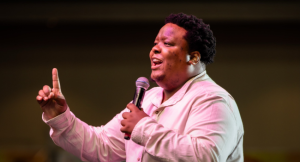
Her latest statement follows a viral video showing the minister addressing worshippers who were recording her during a ministration. In the footage, Orenze called on attendees to put their phones away, arguing that filming during worship can distract people from engaging fully with God and raises questions about reverence in a worship environment.
The incident triggered widespread discussion about the place of mobile phones in church services, with questions emerging over the balance between documenting worship experiences and remaining present during moments of ministry.
Known for her intense worship ministry, uncompromising preaching and songs including “Spirit Chant,” “Covenant Keeping God” and “I Get Backing,” Orenze has established herself as a prominent voice in Nigerian gospel music. Her work has also included collaborations with fellow gospel minister Nathaniel Bassey.
With her latest statement, Orenze has reaffirmed her determination to speak openly about matters she considers spiritually significant, even when her approach attracts criticism. The debate surrounding her remarks continues to raise questions about correction, accountability, reverence and the responsibilities of those who lead worship.
About The Author